Imagine you’ve just read a market-moving headline: BTC gaps higher after an options expiry and you need to move fast. You open your browser or mobile app, type OKX into the bar, and—pause—are you logging into a custodial account, a non-custodial wallet, or trying to bridge funds across chains? That split-second decision determines whether you trade instantly on the spot market, wait for network confirmations, or expose your keys to an unfamiliar smart contract. This article walks through the mechanisms behind OKX’s login and wallet model, how spot trading unfolds there, the security trade-offs you must accept, and practical heuristics US-based traders can use when they need to act quickly and safely.
I’ll address three linked problems: how the OKX account and login system works (and why it’s structured that way), what mechanics matter for spot trading on the exchange, and when to use OKX’s custodial exchange versus its non-custodial Web3 wallet. Expect concrete steps, one useful mental model for trade decisions, and limits you should treat as hard constraints rather than negotiable features.
How OKX Login and Account Protection Actually Work
At core, OKX uses a hybrid security model typical of modern exchanges: strong centralized controls to meet regulatory obligations and optional non-custodial tooling for Web3 interactions. Account creation requires Know Your Customer (KYC) verification—submit government ID and complete a facial liveness check—to comply with AML rules. Once an account exists, access is defended by layered protections: military-grade encryption, AI-driven monitoring that flags anomalous login patterns, and mandatory Two-Factor Authentication (2FA) using SMS, Google Authenticator, or biometric unlocks on mobile.
Mechanically, this means your browser session ties to a server-side profile. When you log in, the server validates credentials, checks device and geolocation signals, and may require step-up verification (additional captcha, re-authentication) if the system detects risk. For US users this reduces fraud risk but also creates single-point-of-access failure modes: account lockouts during travel, delays if identity documents don’t match exactly, and reliance on the exchange’s account-recovery procedures. Those procedures exist, but they are administrative friction you cannot erase with stronger passwords alone.
One practical implication: if you anticipate needing frequent, rapid trades—for example, reacting to short-term market moves—set up and test multiple approved devices (desktop and mobile) and enable biometrics on your phone. Also register hardware 2FA options where supported. If you are logging in from a new IP or VPN, expect extra checks; plan for that in a time-sensitive scenario.
Spot Trading on OKX: Mechanics, Costs, and Critical Limits
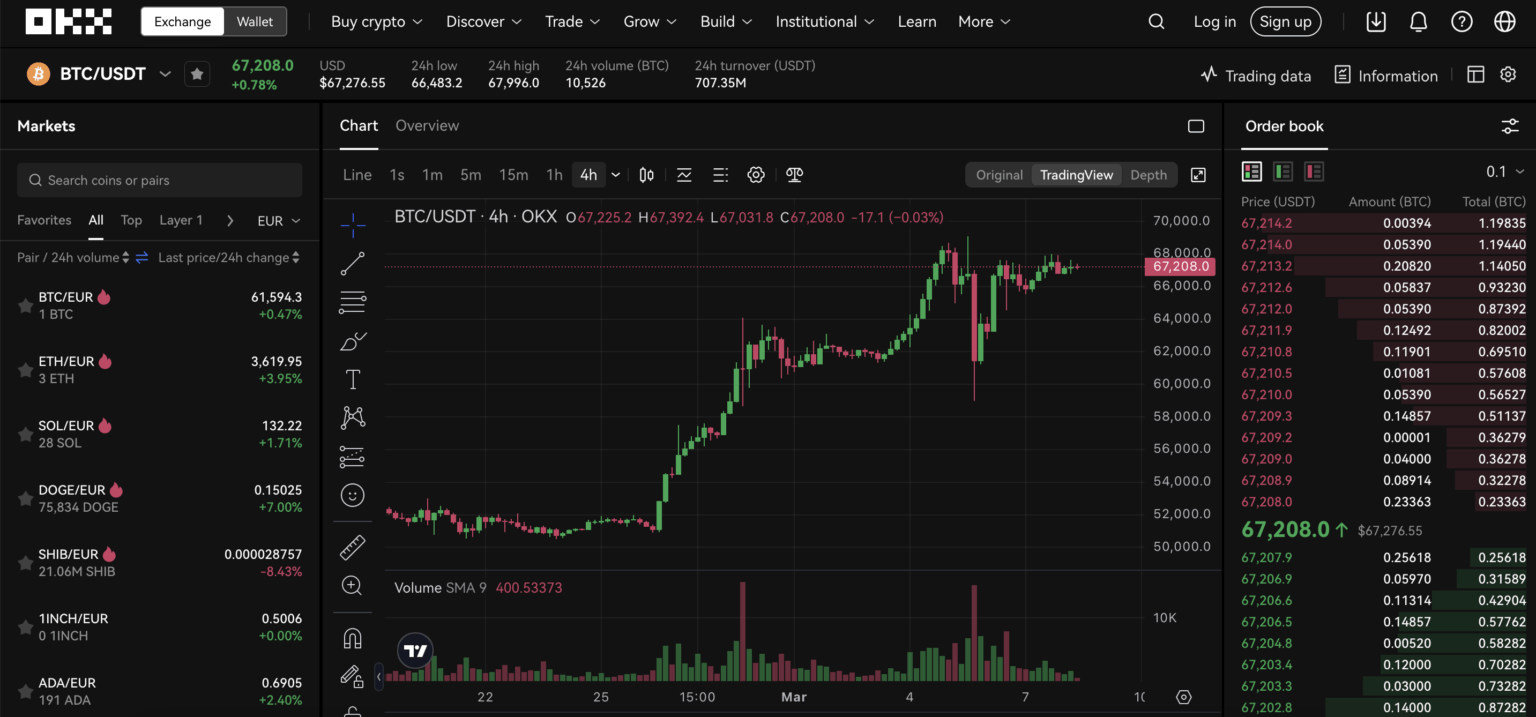
Spot trading on OKX is straightforward in concept—buy and sell assets at the current market price—but the operational details determine whether you actually capture the price you expect. OKX supports over 300 cryptocurrencies across more than 130 blockchains, which creates both choice and complication: liquidity for BTC and ETH pairs is deep and tight; low-volume altcoins can exhibit wide bid-ask spreads and surprising slippage during fast moves.
Order types and routing matter. Market orders execute against the orderbook immediately and are useful when speed is more important than price. Limit orders give you price control but risk non-execution. OKX’s matching engine routes orders against centralized orderbooks; for cross-chain or DEX liquidity, the platform also aggregates decentralized routes via its DEX aggregator to find efficient swaps. For US traders the best practice is: use limit orders at reasonable spreads during calm markets and reserve market orders for defined, time-critical exits—never as a default execution strategy.
Leverage and margin are available up to 10x for spot margin modes (isolated or cross). That amplifies gains and losses and interacts badly with low liquidity. A practical heuristic: only use margin when pair liquidity is above a threshold you can measure in real time (tight spread, high 24-hour volume) and when you have stop-loss discipline. In the absence of guaranteed stop orders during extreme volatility, forced liquidations can occur at unfavorable prices.
Recent platform housekeeping is a concrete operational reminder: in March 2026 OKX delisted several spot pairs (RSS3, MemeFi, GHST, RIO, SWEAT). Exchanges routinely prune illiquid or risky pairs to reduce market manipulation risk and protect users. For traders, delistings mean two things: (1) keep an eye on pair liquidity as a signal—pairs that thin out are candidates for delisting; (2) maintain an exit plan so funds are not trapped when a token is scheduled for removal.
Custodial vs Non-Custodial: Wallet Choices and When to Use Each
OKX offers both a custodial exchange wallet (your assets held on-platform with the exchange’s custody controls) and a non-custodial Web3 wallet where you control the seed phrase and can connect hardware devices like Ledger or Trezor. Understanding the mechanism is crucial: custodial holdings trade instantly within the exchange’s internal accounting system; non-custodial holdings live on-chain and require on-chain transactions to move funds into or out of the exchange, with associated gas costs and confirmation delays.
Security trade-offs are the classic ones. Custodial: strong cold storage practices (OKX stores over 95% of assets offline in multi-signature cold wallets) and Proof of Reserves transparency help reduce counterparty risk, but you still rely on exchange protections against social engineering and operational errors. Non-custodial: you hold the keys—no counterparty risk from the exchange—but you face irreversible loss if the seed phrase is lost or stolen and greater exposure to smart contract bugs when interacting with DeFi.
For a US trader deciding where to keep funds, a simple rule of thumb: keep short-term trading balances on the exchange (an amount you would reasonably trade within days) and larger longer-term positions in a non-custodial wallet with hardware backup. When moving assets between them, prefer off-peak times to reduce on-chain fees and use the DEX aggregator only when bridge liquidity and fees make it competitive with centralized transfers.
If you need to revisit login and account details for OKX specifically, the exchange’s web login guidance is a useful procedural reference: https://sites.google.com/cryptowalletextensionus.com/okx-login-web/
Where the System Breaks and What to Watch Next
The most important limitations are external and systemic. First, regulatory pressure in the US can change product availability quickly; exchanges adjust trading pairs and features to comply, which may affect margin products or types of tokens you can trade. Second, on-chain risks—smart contract exploits, bridge hacks—remain active threats when you leave the exchange’s custody. Third, user operational errors (lost seed phrases, credential phishing) are a leading cause of loss and are independent of OKX’s internal protections.
Signals to monitor that have practical decision value: sudden spreads widening on a pair (liquidity drying up), platform announcements about delistings (as in March 2026), and changes to KYC/withdrawal policies. If you see any of these, move from “optimizing” mode into “protect assets” mode: reduce leveraged exposure, tighten stop-losses, and consider withdrawing illiquid holdings to a non-custodial wallet where you control recovery options.
Decision-Useful Heuristics and a Mental Model
Here’s a compact mental model to guide fast choices: treat custody as a spectrum, not a binary. Short time horizon + high frequency = custodial. Long time horizon + minimal trading = non-custodial. If the trade requires cross-chain swaps or interacting with DeFi contracts, always assume additional time and security checks. Before executing spot trades under time pressure, ask three quick questions: (1) Is liquidity sufficient to absorb my order size without >1% slippage? (2) Am I using market or limit execution, and do I accept the price risk? (3) Does this trade require moving funds on-chain first (time + fees)? Answering these reduces impulse mistakes.
FAQ
Do I need KYC to log in and trade on OKX from the US?
Yes. Account creation on OKX requires KYC verification (government ID and facial liveness check) to meet AML regulations. You can browse some public pages without KYC, but trading, deposits, and withdrawals will require a verified account.
Is it safer to keep all my crypto on OKX given their cold storage and Proof of Reserves?
Safe is relative. OKX’s cold storage and Proof of Reserves reduce counterparty risk compared with smaller platforms, but custody still concentrates risk with the exchange. For amounts you do not plan to trade, a non-custodial hardware-backed wallet reduces counterparty exposure at the cost of requiring you to manage recovery securely.
How does delisting affect my positions?
When OKX delists a spot pair, it typically provides a window to withdraw or trade out your holdings. That window and the mechanics vary; delistings occur when liquidity or regulatory risk justifies removal. Monitor announcements and convert or withdraw affected assets before the delisting deadline to avoid forced conversions at unfavorable prices.
Can I use hardware wallets with OKX’s Web3 wallet?
Yes. The OKX non-custodial wallet supports hardware integrations such as Ledger and Trezor, which is a recommended way to balance Web3 usability with stronger key protection.
Final takeaway: OKX packs a lot of options—deep spot markets for major coins, margin for amplification, and a non-custodial Web3 layer—but each feature is an explicit trade-off between speed, control, and risk. For US traders, the practical path is to design a custody and trading pattern that maps directly to your time horizon and liquidity needs, test your login and recovery flows before market-moving moments, and treat exchange announcements (like routine delistings) as operational signals, not mere noise.